

- University
- Academic
- Schools/Vocational Schools
- Vocational School of Justice
- Vocational School
- Vocational School
- Department of Banking and Insurance (Turkish)
- Department of Computer Programming (Turkish)
- Department of Foreign Trade (Turkish)
- Department of Graphic Design (Turkish)
- Department of Interior Design (Turkish)
- Department of Construction Technology (Turkish)
- Department of Occupational Health and Safety (Turkish)
- Department of Media and Communication (Turkish)
- Department of Architectural Restoration (Turkish)
- Department of Radio and Tv Programming (Turkish)
- Department of Civil Aviation Cabin Services (Turkish)
- Department of Civil Aviation Transportation Management (Turkish)
- Department of Tourism and Hotel Management (Turkish)
- Department of Applied English Translation
- Vocational School Of Health Services
- Vocational School Of Health Services
- Department of Child Development (Turkish)
- Department of Physiotherapy (Turkish)
- Department of Paramedic (Turkish)
- Department of Opticianry (Turkish)
- Department of Medical Documentation and Secreteriat (Turkish)
- Department of Medical Imaging Techniques (Turkish)
- Department of Medical Laboratory Techniques (Turkish)
- Department of Elderly Care (Turkish)
- School of Applied Management Sciences
- School of Foreign Languages
- Faculties
- Faculty of Arts and Sciences
- Faculty of Fine Arts and Design
- Faculty of Law
- Faculty of Communication
- Faculty of Business
- Faculty of Engineering
- Faculty of Engineering
- Department of Computer Engineering
- Department of Biomedical Engineering
- Department of Electrical and Electronics Engineering
- Department of Industrial Engineering
- Department of Food Engineering
- Department of Genetics and Bioengineering
- Department of Aerospace Engineering
- Department of Civil Engineering
- Department of Mechanical Engineering
- Department of Mechatronics Engineering
- Department of Software Engineering
- Faculty of Health Sciences
- Medicine
- Graduate School
- Common Courses
- Schools/Vocational Schools
- Research
- Research Centers
- Library
- Smart Campus
- Technology Transfer Office
- İzmir Sciencepark
- Continuous Education Center (EKOSEM)
- Children's University
- Ethics Committee
- Teaching and Learning Center (EKOEĞİTİM)
- Psychology Application and Research Center
- Researcher Training Coordinatorship
- Research Collaborations And Innovation Coordinatorship
- Campus
- INTERNATIONAL
- Contact
- 25TH YEAR
Department of Economics
GEHU 212 | Course Introduction and Application Information
| Course Name |
History Of Izmir
|
|
Code
|
Semester
|
Theory
(hour/week) |
Application/Lab
(hour/week) |
Local Credits
|
ECTS
|
|
GEHU 212
|
Fall/Spring
|
3
|
0
|
0
|
4
|
| Prerequisites |
None
|
|||||
| Course Language |
English
|
|||||
| Course Type |
Service Course
|
|||||
| Course Level |
-
|
|||||
| Mode of Delivery | - | |||||
| Teaching Methods and Techniques of the Course | DiscussionGroup WorkQ&ALecture / Presentation | |||||
| National Occupation Classification | - | |||||
| Course Coordinator | ||||||
| Course Lecturer(s) | ||||||
| Assistant(s) | - | |||||
| Course Objectives | The purpose of this course is to analyze the local and regional history of Izmir from an analytical perspective within the context of Mediterranean and world history. The course aims to examine the city's geographical and strategic significance, its character as a major port and trade center, its multicultural social structure, and its institutional and socio-cultural transformations during the National War of Independence and the Republican Era, utilizing primary and secondary historical sources as well as tangible urban-architectural heritage. |
| Learning Outcomes |
The students who succeeded in this course;
|
| Course Description | The History of Izmir course examines the political, socio-economic, architectural, and cultural development of Izmir from antiquity to the present day. Within the scope of the course, the historical transformation of Izmir as a major Eastern Mediterranean port city during the Principalities, Ottoman, and Republican eras, its position in trade networks, cosmopolitan urban structure, strategic role in the National War of Independence, and contributions to Republican modernization are addressed through urban history methodology and a multicultural heritage framework. |
| Related Sustainable Development Goals |
|
|
|
Core Courses | |
| Major Area Courses | ||
| Supportive Courses | ||
| Media and Management Skills Courses | ||
| Transferable Skill Courses |
WEEKLY SUBJECTS AND RELATED PREPARATION STUDIES
| Week | Subjects | Related Preparation |
| 1 | Introduction: Objectives and Expectations Smyrna: Sources of Izmir History and General Information About The Course | Muhterem İlgüner, İzmir/Smyrna; The Portrait Of The City, Arkadaş Press, İzmir, 2005, 10-16 |
| 2 | Urban History and Urbanism | Sibel Zandi Sayek, Ottoman Izmir, University Of Minnesota Press, London, 2001, 75-115 |
| 3 | Izmir in Prehistoric Times and Antiquity | Rıfat Bali, A Survey Of Some Social Conditions In Smyrna, Asia Minor May 1921 Libra Printing, İstanbul, 1st Edition, 19-27 Republic of Turkey Ministry of Culture and Tourism. “Smyrna in Ancient Times.” Accessed June 25, 2015. http://www.kultur.gov.tr/EN,34491/smyrna- in-ancienttimes.html. |
| 4 | Izmir under the Rule of Roman and Byzantine Empire/Technical Trip | Republic of Turkey Izmir Governorship. “History of Izmir.” Accessed June 25, 2015. http://www.izmir.gov.tr/tarih-e. |
| 5 | First Turkish Polities in Izmir | M.Yavuz Çorapçıoğlu, From Smyrna To Izmir, First Printing, Ankara, 2019, 45-64 |
| 6 | Ottoman Empire: Izmir Between XVII-XX. Centuries | Karpat, Kemal H. Ottoman Population 1830-1914 Demographic and Social Characteristics. Wisconsin: The University of Wisconsin Press, 1985.120-140 |
| 7 | Izmir And National Struggle | M.Yavuz Çorapçıoğlu, From Smyrna To Izmir, First Printing, Ankara, 2019, 472- 504 |
| 8 | Midterm Exam | |
| 9 | Izmir in the Modernization Process of Turkish Republic | Michael M. Finefrock, Laissez Faire, The 1923 Izmir Economic Congress and Early Turkish Developmental Policy in Political Perspective, Middle Eastern Studies, Vol.17, No.3, 1981, 375-392 |
| 10 | Izmir and Important Personalities | Daniel Goffman (2000). İzmir and the Levantine world (1550–1650). University of Washington, 40-62 |
| 11 | Historical Places in and around Izmir/Technical trip | Muhterem İlgüner, İzmir/Smyrna; The Portrait Of The City, Arkadaş Press, İzmir, 2005, 52-88 |
| 12 | Culinary Culture in Izmir | M.Yavuz Çorapçıoğlu, From Smyrna To Izmir, First Printing, Ankara, 2019, 472- 504256-262 |
| 13 | Izmir and Press, Education and Cultural Life | Rıfat Bali, A Survey Of Some Social Conditions In Smyrna, Asia Minor May 1921 Libra Printing, İstanbul, 1st Edition, 179-210. M.Yavuz Çorapçıoğlu, From Smyrna To Izmir, First Printing, Ankara, 2019, 409- 450 |
| 14 | Minorities in Izmir | Muhterem İlgüner, İzmir/Smyrna; The Portrait Of The City, Arkadaş Press, İzmir, 2005, 28-32 |
| 15 | Review of the semester | |
| 16 | Final exam |
| Course Notes/Textbooks | |
| Suggested Readings/Materials |
EVALUATION SYSTEM
| Semester Activities | Number | Weigthing |
| Participation | ||
| Laboratory / Application | ||
| Field Work | ||
| Quizzes / Studio Critiques |
2
|
20
|
| Portfolio | ||
| Homework / Assignments | ||
| Presentation / Jury |
1
|
20
|
| Project | ||
| Seminar / Workshop | ||
| Oral Exams | ||
| Midterm |
1
|
25
|
| Final Exam |
1
|
35
|
| Total |
| Weighting of Semester Activities on the Final Grade |
4
|
65
|
| Weighting of End-of-Semester Activities on the Final Grade |
1
|
35
|
| Total |
ECTS / WORKLOAD TABLE
| Semester Activities | Number | Duration (Hours) | Workload |
|---|---|---|---|
| Theoretical Course Hours (Including exam week: 16 x total hours) |
16
|
3
|
48
|
| Laboratory / Application Hours |
16
|
0
|
|
| Study Hours Out of Class |
14
|
1
|
14
|
| Field Work |
0
|
||
| Quizzes / Studio Critiques |
2
|
8
|
16
|
| Portfolio |
0
|
||
| Homework / Assignments |
0
|
||
| Presentation / Jury |
1
|
10
|
10
|
| Project |
0
|
||
| Seminar / Workshop |
0
|
||
| Oral Exam |
0
|
||
| Midterms |
1
|
15
|
15
|
| Final Exam |
1
|
20
|
20
|
| Total |
123
|
COURSE LEARNING OUTCOMES AND PROGRAM QUALIFICATIONS RELATIONSHIP
|
#
|
Program Competencies/Outcomes |
* Contribution Level
|
|||||
|
1
|
2
|
3
|
4
|
5
|
|||
| 1 |
To be able to acquire a sound knowledge of fundamental concepts, theories, principles and methods of investigation specific to the economic field. |
-
|
-
|
-
|
-
|
-
|
|
| 2 |
To be able to apply adequate mathematical, econometric, statistical and data analysis models to process economic data and to implement scientific research for development of economic policies. |
-
|
-
|
-
|
-
|
-
|
|
| 3 |
To be able to participate in academic, professional, regional, and global networks and to utilize these networks efficiently. |
-
|
-
|
-
|
-
|
-
|
|
| 4 |
To be able to have adequate social responsibility with regards to the needs of the society and to organize the activities to influence social dynamics in line with social goals. |
-
|
-
|
-
|
-
|
-
|
|
| 5 |
To be able to integrate the knowledge and training acquired during the university education with personal education and produce a synthesis of knowledge one requires. |
-
|
-
|
-
|
-
|
-
|
|
| 6 |
To be able to evaluate his/her advance level educational needs and do necessary planning to fulfill those needs through the acquired capability to think analytically and critically. |
-
|
-
|
-
|
-
|
-
|
|
| 7 |
To be able to acquire necessary skills to integrate social dynamics into economic process both as an input and an output. |
-
|
-
|
-
|
-
|
-
|
|
| 8 |
To be able to link accumulated knowledge acquired during the university education with historical and cultural qualities of the society and be able to convey it to different strata of society. |
-
|
-
|
-
|
-
|
-
|
|
| 9 |
To be able to take the responsibility as an individual and as a team member. |
-
|
-
|
-
|
-
|
-
|
|
| 10 |
To be able to attain social, scientific and ethical values at the data collection, interpretation and dissemination stages of economic analysis. |
-
|
-
|
-
|
-
|
-
|
|
| 11 |
To be able to collect data in economics and communicate with colleagues in a foreign language ("European Language Portfolio Global Scale", Level B1) |
-
|
-
|
-
|
-
|
-
|
|
| 12 |
To be able to speak a second foreign language at a medium level of fluency efficiently. |
-
|
-
|
-
|
-
|
-
|
|
| 13 |
To be able to relate the knowledge accumulated throughout human history to their field of economics. |
-
|
-
|
-
|
-
|
-
|
|
*1 Lowest, 2 Low, 3 Average, 4 High, 5 Highest
NEWSALL NEWS


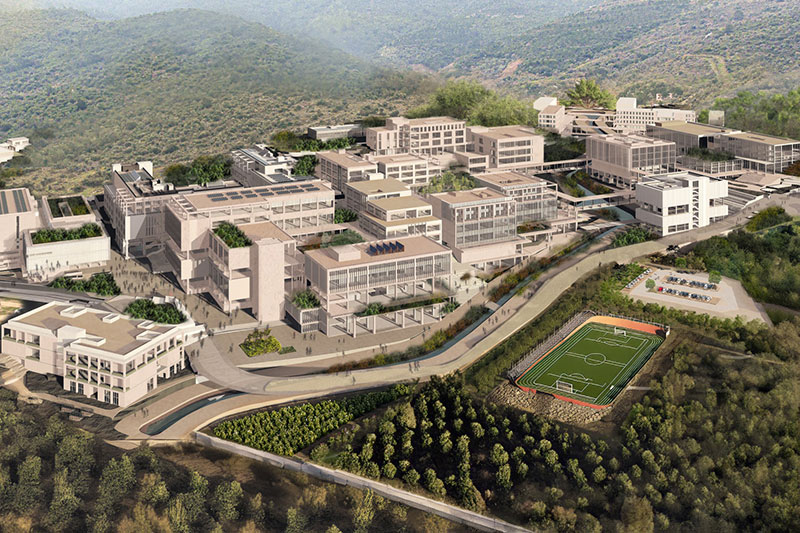
IZMIR UNIVERSITY OF ECONOMICS GÜZELBAHÇE CAMPUS
DetailsGLOBAL CAREER
As Izmir University of Economics transforms into a world-class university, it also raises successful young people with global competence.
More..CONTRIBUTION TO SCIENCE
Izmir University of Economics produces qualified knowledge and competent technologies.
More..VALUING PEOPLE
Izmir University of Economics sees producing social benefit as its reason for existence.
More..
You are one step ahead with your graduate education at Izmir University of Economics.