
- University
- Academic
- Schools/Vocational Schools
- Vocational School of Justice
- Vocational School
- Vocational School
- Department of Banking and Insurance (Turkish)
- Department of Computer Programming (Turkish)
- Department of Foreign Trade (Turkish)
- Department of Graphic Design (Turkish)
- Department of Interior Design (Turkish)
- Department of Construction Technology (Turkish)
- Department of Occupational Health and Safety (Turkish)
- Department of Media and Communication (Turkish)
- Department of Architectural Restoration (Turkish)
- Department of Radio and Tv Programming (Turkish)
- Department of Civil Aviation Cabin Services (Turkish)
- Department of Civil Aviation Transportation Management (Turkish)
- Department of Tourism and Hotel Management (Turkish)
- Department of Applied English Translation
- Vocational School Of Health Services
- Vocational School Of Health Services
- Department of Child Development (Turkish)
- Department of Physiotherapy (Turkish)
- Department of Paramedic (Turkish)
- Department of Opticianry (Turkish)
- Department of Medical Documentation and Secreteriat (Turkish)
- Department of Medical Imaging Techniques (Turkish)
- Department of Medical Laboratory Techniques (Turkish)
- Department of Elderly Care (Turkish)
- School of Applied Management Sciences
- School of Foreign Languages
- Faculties
- Faculty of Arts and Sciences
- Faculty of Fine Arts and Design
- Faculty of Law
- Faculty of Communication
- Faculty of Business
- Faculty of Engineering
- Faculty of Engineering
- Department of Computer Engineering
- Department of Biomedical Engineering
- Department of Electrical and Electronics Engineering
- Department of Industrial Engineering
- Department of Food Engineering
- Department of Genetics and Bioengineering
- Department of Aerospace Engineering
- Department of Civil Engineering
- Department of Mechanical Engineering
- Department of Mechatronics Engineering
- Department of Software Engineering
- Faculty of Health Sciences
- Medicine
- Graduate School
- Common Courses
- Schools/Vocational Schools
- Research
- Research Centers
- Library
- Smart Campus
- Technology Transfer Office
- İzmir Sciencepark
- Continuous Education Center (EKOSEM)
- Children's University
- Ethics Committee
- Teaching and Learning Center (EKOEĞİTİM)
- Psychology Application and Research Center
- Researcher Training Coordinatorship
- Research Collaborations And Innovation Coordinatorship
- Campus
- INTERNATIONAL
- Contact
- 25TH YEAR
Department of Economics
GEET 312 | Course Introduction and Application Information
| Course Name |
History of the Women’s Rights Movement
|
|
Code
|
Semester
|
Theory
(hour/week) |
Application/Lab
(hour/week) |
Local Credits
|
ECTS
|
|
GEET 312
|
Fall/Spring
|
3
|
0
|
3
|
6
|
| Prerequisites |
None
|
|||||
| Course Language |
English
|
|||||
| Course Type |
Service Course
|
|||||
| Course Level |
First Cycle
|
|||||
| Mode of Delivery | - | |||||
| Teaching Methods and Techniques of the Course | DiscussionGroup WorkQ&ALecture / Presentation | |||||
| National Occupation Classification | - | |||||
| Course Coordinator | ||||||
| Course Lecturer(s) | ||||||
| Assistant(s) | - | |||||
| Course Objectives | This course examines the history of the women’s rights movement and will analyze the ways that women have mobilized over the 20th and 21st centuries. Historical analysis will be used to trace how the women’s rights movement began, evolved and the divisions among different women’s groups. A special emphasis will be made on the history of the women’s rights movement in Turkey. |
| Learning Outcomes |
The students who succeeded in this course;
|
| Course Description | This course aims to give students insight into women’s rights movement of the 20th and 21st century by comparing and contrasting the different waves of feminism. The contribution of international organizations, particularly the United Nations will be discussed in greater detail and a special emphasis will be made on the women’s rights movement in Turkey. |
| Related Sustainable Development Goals |
|
|
|
Core Courses | |
| Major Area Courses | ||
| Supportive Courses | ||
| Media and Management Skills Courses | ||
| Transferable Skill Courses |
WEEKLY SUBJECTS AND RELATED PREPARATION STUDIES
| Week | Subjects | Related Preparation |
| 1 | Introduction | - |
| 2 | Basic Concepts | • Walby, S.(1989), “Theorizing Patriarchy”, Sociology, pp. 213-234. • Valdes, F., “Unpacking Hetero-Patriarchy”, pp. 161-211. Suggested: • Blank, H. (2012), Straight: The Surprisingly Short History of Heterosexuality. |
| 3 | Historical Background | • Aivazova, Svetlena (1994). “Towards a History of Feminism”, Russian Studies in History, pp. 63-69. Suggested: • Okin, Susan Moller (1979). “Rousseau’s Natural Women”, The Journal of Politics, pp. 393-416. |
| 4 | Early and First Wave Feminism | • Hodgson-Wright, S. (2001), “Early Feminism”, in The Routledge Companion to Feminism and Postfeminisms, pp. 3-15 • Sanders, V. (2001), “First Wave Feminism,” in The Routledge Companion to Feminism and Postfeminisms, pp. 16-28. |
| 5 | Movie: “Iron Jawed Angels” by Katja von Garnier3 | https://suffrageandthemedia.org/source/iron-jawed-angels-film-suffrage-activists/ |
| 6 | Second Wave Feminism | • Thornham, S. (2001), “Second Wave Feminism”, in The Routledge Companion to Feminism and Postfeminisms, pp.29-42. Suggested: • Duru Dogan, H. (2010). İkinci Dalga Fransız Feminizmine Kısa Bir Bakış, Türkiye’de Toplumsal Cinsiyet Çalışmaları, pp. 67-99. |
| 7 | Second Wave Feminism Movie Screening: “Made in Dagenham” by Nigel Cole | • Thornham, S. (2001), “Second Wave Feminism”, in The Routledge Companion to Feminism and Postfeminisms, pp.29-42. Suggested: • Duru Dogan, H. (2010). İkinci Dalga Fransız Feminizmine Kısa Bir Bakış, Türkiye’de Toplumsal Cinsiyet Çalışmaları, pp. 67-99. |
| 8 | Third Wave Feminism | • Gamble, S. (2001), “Postfeminism”, in The Routledge Companion to Feminism and Postfeminisms, pp. 43-54. Suggested • Hokulani K. Aikau, Erickson K.& Pierce, J.L. (2018). “Feminism, First-, Second-, and Third-Wave”, in The International Encyclopedia of Anthropology. • Rivers, N. (2017). Postfeminism(s) and the arrival of the Fourth Wave. pp. 107 -131. |
| 9 | Ottoman Woman’s Movement | • Serpil Çakır (201 0 ) . Osmanlı Kadın Hareketi: XX. Yüzyılın Başında Kadınların Hak Mücadelesi. Türkiye’de Toplumsal Cinsiyet Çalışmaları . pp. 99 -115. • Demirdirek, A. (1998). In pursuit of the Ottoman Women's Movement (Translated by Zehra F. Arat), in Deconstructing images of the Turkish woman, pp.65 -83. |
| 10 | Mid-term | - |
| 11 | Feminism in Turkey I | • Sirman, Nükhet (1989). Feminism in Turkey: A Short History, New Perspectives on Turkey, 1 -33. • C Diner, Ş Toktaş (2010). Waves of feminism in Turkey: Kemalist, Islamist and Kurdish women's movements in an era of globalization, Journal of Balkan and Near Eastern Studies, pp.41 – 57 |
| 12 | Feminism in Turkey II | • Miller, Ruth A. (2007). Rights, Reproduction, Sexuality, and Citizenship in the Ottoman Empire and Turkey, Signs: Journal of Women in Culture and Society, vol. 32, no. 2. • Coşar, Simten & Kerestecioğlu, İnci -Özkan (2013). Feminizmin Neoliberalizmle İmtihanı, Doğu Batı Toplumsal Cinsiyet II, pp. 21 -37. |
| 13 | Presentations | - |
| 14 | Presentations | |
| 15 | Review of the Semester | |
| 16 | Final Exam |
| Course Notes/Textbooks | Lecture notes will be uploaded to Blackboard/ GEET 312/Materials section.
|
| Suggested Readings/Materials | They will be uploaded to Blackboard/GEET 312/ Materials section. |
EVALUATION SYSTEM
| Semester Activities | Number | Weigthing |
| Participation |
1
|
10
|
| Laboratory / Application | ||
| Field Work | ||
| Quizzes / Studio Critiques | ||
| Portfolio | ||
| Homework / Assignments | ||
| Presentation / Jury |
1
|
25
|
| Project | ||
| Seminar / Workshop | ||
| Oral Exams | ||
| Midterm |
1
|
30
|
| Final Exam |
1
|
35
|
| Total |
| Weighting of Semester Activities on the Final Grade |
3
|
65
|
| Weighting of End-of-Semester Activities on the Final Grade |
1
|
35
|
| Total |
ECTS / WORKLOAD TABLE
| Semester Activities | Number | Duration (Hours) | Workload |
|---|---|---|---|
| Theoretical Course Hours (Including exam week: 16 x total hours) |
16
|
3
|
48
|
| Laboratory / Application Hours |
16
|
0
|
|
| Study Hours Out of Class |
15
|
3
|
45
|
| Field Work |
0
|
||
| Quizzes / Studio Critiques |
0
|
||
| Portfolio |
0
|
||
| Homework / Assignments |
0
|
||
| Presentation / Jury |
1
|
10
|
10
|
| Project |
0
|
||
| Seminar / Workshop |
0
|
||
| Oral Exam |
0
|
||
| Midterms |
1
|
14
|
14
|
| Final Exam |
1
|
39
|
39
|
| Total |
156
|
COURSE LEARNING OUTCOMES AND PROGRAM QUALIFICATIONS RELATIONSHIP
|
#
|
Program Competencies/Outcomes |
* Contribution Level
|
|||||
|
1
|
2
|
3
|
4
|
5
|
|||
| 1 |
To be able to acquire a sound knowledge of fundamental concepts, theories, principles and methods of investigation specific to the economic field. |
-
|
-
|
-
|
-
|
-
|
|
| 2 |
To be able to apply adequate mathematical, econometric, statistical and data analysis models to process economic data and to implement scientific research for development of economic policies. |
-
|
-
|
-
|
-
|
-
|
|
| 3 |
To be able to participate in academic, professional, regional, and global networks and to utilize these networks efficiently. |
-
|
-
|
-
|
-
|
-
|
|
| 4 |
To be able to have adequate social responsibility with regards to the needs of the society and to organize the activities to influence social dynamics in line with social goals. |
-
|
-
|
-
|
-
|
-
|
|
| 5 |
To be able to integrate the knowledge and training acquired during the university education with personal education and produce a synthesis of knowledge one requires. |
-
|
-
|
-
|
-
|
-
|
|
| 6 |
To be able to evaluate his/her advance level educational needs and do necessary planning to fulfill those needs through the acquired capability to think analytically and critically. |
-
|
-
|
-
|
-
|
-
|
|
| 7 |
To be able to acquire necessary skills to integrate social dynamics into economic process both as an input and an output. |
-
|
-
|
-
|
-
|
-
|
|
| 8 |
To be able to link accumulated knowledge acquired during the university education with historical and cultural qualities of the society and be able to convey it to different strata of society. |
-
|
-
|
-
|
-
|
-
|
|
| 9 |
To be able to take the responsibility as an individual and as a team member. |
-
|
-
|
-
|
-
|
-
|
|
| 10 |
To be able to attain social, scientific and ethical values at the data collection, interpretation and dissemination stages of economic analysis. |
-
|
-
|
-
|
-
|
-
|
|
| 11 |
To be able to collect data in economics and communicate with colleagues in a foreign language ("European Language Portfolio Global Scale", Level B1) |
-
|
-
|
-
|
-
|
-
|
|
| 12 |
To be able to speak a second foreign language at a medium level of fluency efficiently. |
-
|
-
|
-
|
-
|
-
|
|
| 13 |
To be able to relate the knowledge accumulated throughout human history to their field of economics. |
-
|
-
|
-
|
-
|
-
|
|
*1 Lowest, 2 Low, 3 Average, 4 High, 5 Highest
NEWSALL NEWS


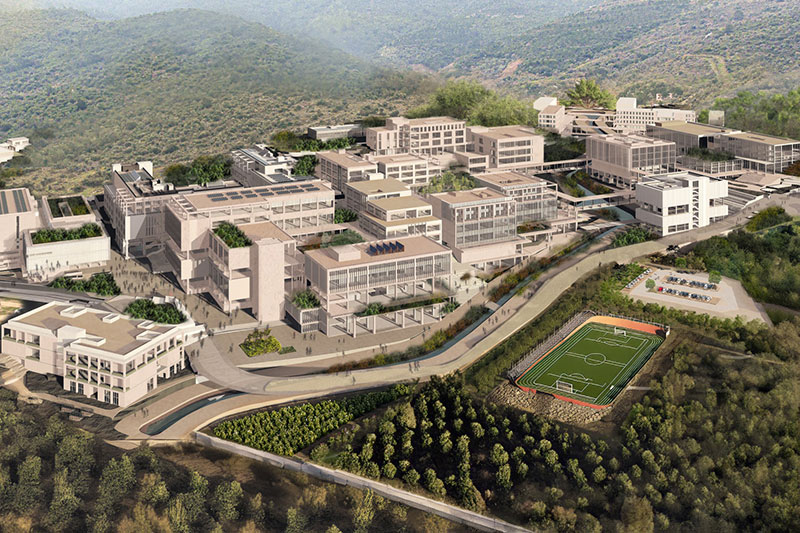
IZMIR UNIVERSITY OF ECONOMICS GÜZELBAHÇE CAMPUS
DetailsGLOBAL CAREER
As Izmir University of Economics transforms into a world-class university, it also raises successful young people with global competence.
More..CONTRIBUTION TO SCIENCE
Izmir University of Economics produces qualified knowledge and competent technologies.
More..VALUING PEOPLE
Izmir University of Economics sees producing social benefit as its reason for existence.
More..
You are one step ahead with your graduate education at Izmir University of Economics.