


- University
- Academic
- Schools/Vocational Schools
- Vocational School of Justice
- Vocational School
- Vocational School
- Department of Banking and Insurance (Turkish)
- Department of Computer Programming (Turkish)
- Department of Foreign Trade (Turkish)
- Department of Graphic Design (Turkish)
- Department of Interior Design (Turkish)
- Department of Construction Technology (Turkish)
- Department of Occupational Health and Safety (Turkish)
- Department of Media and Communication (Turkish)
- Department of Architectural Restoration (Turkish)
- Department of Radio and Tv Programming (Turkish)
- Department of Civil Aviation Cabin Services (Turkish)
- Department of Civil Aviation Transportation Management (Turkish)
- Department of Tourism and Hotel Management (Turkish)
- Department of Applied English Translation
- Vocational School Of Health Services
- Vocational School Of Health Services
- Department of Child Development (Turkish)
- Department of Physiotherapy (Turkish)
- Department of Paramedic (Turkish)
- Department of Opticianry (Turkish)
- Department of Medical Documentation and Secreteriat (Turkish)
- Department of Medical Imaging Techniques (Turkish)
- Department of Medical Laboratory Techniques (Turkish)
- Department of Elderly Care (Turkish)
- School of Applied Management Sciences
- School of Foreign Languages
- Faculties
- Faculty of Arts and Sciences
- Faculty of Fine Arts and Design
- Faculty of Law
- Faculty of Communication
- Faculty of Business
- Faculty of Engineering
- Faculty of Engineering
- Department of Computer Engineering
- Department of Biomedical Engineering
- Department of Electrical and Electronics Engineering
- Department of Industrial Engineering
- Department of Food Engineering
- Department of Genetics and Bioengineering
- Department of Aerospace Engineering
- Department of Civil Engineering
- Department of Mechanical Engineering
- Department of Mechatronics Engineering
- Department of Software Engineering
- Faculty of Health Sciences
- Medicine
- Graduate School
- Common Courses
- Schools/Vocational Schools
- Research
- Research Centers
- Library
- Smart Campus
- Technology Transfer Office
- İzmir Sciencepark
- Continuous Education Center (EKOSEM)
- Children's University
- Ethics Committee
- Teaching and Learning Center (EKOEĞİTİM)
- Psychology Application and Research Center
- Researcher Training Coordinatorship
- Research Collaborations And Innovation Coordinatorship
- Campus
- INTERNATIONAL
- Contact
- 25TH YEAR
Department of Economics
BUS 220 | Course Introduction and Application Information
| Course Name |
Data Analytics for Business and Economics
|
|
Code
|
Semester
|
Theory
(hour/week) |
Application/Lab
(hour/week) |
Local Credits
|
ECTS
|
|
BUS 220
|
Spring
|
2
|
2
|
3
|
5
|
| Prerequisites |
None
|
|||||
| Course Language |
English
|
|||||
| Course Type |
Required
|
|||||
| Course Level |
First Cycle
|
|||||
| Mode of Delivery | - | |||||
| Teaching Methods and Techniques of the Course | Application: Experiment / Laboratory / WorkshopLecture / Presentation | |||||
| National Occupation Classification | - | |||||
| Course Coordinator | ||||||
| Course Lecturer(s) | ||||||
| Assistant(s) | ||||||
| Course Objectives | Processing analysis of data is a requirement for all professionals in today’s digital environment. This course aims to develop fundamental data analytics skills necessary in the business and economic fields. |
| Learning Outcomes |
The students who succeeded in this course;
|
| Course Description | This course aims to develop data processing and analysis skills required in the fields of business and economics. In this course students learn computer coding skills focused on data processes, with case studies in their fields. In contrast to coding courses for students aiming an expertise in computing, this course approaches algorithms in terms of their function in business and economics problems and focuses on features and applications of data processing patterns. In this applied course students learn the programming languages Python and R, which are very common in business practice and research. In addition, the course covers the properties of big data analytics and technologies used for it. The course consists of three modules: 1-Big data (2 weeks): technologies (Hadoop, MapReduce), competencies, real time data processing, possible value creation pipelines in big data 2-Statistical processing with R (6 weeks): Exploratory statistics in R. 3-Introduction to coding for data analytics with Python (6 weeks): data types, searching/sorting, list processing for statistical calculations, web scraping for data |
| Related Sustainable Development Goals |

|
|
|
Core Courses | |
| Major Area Courses | ||
| Supportive Courses | ||
| Media and Management Skills Courses | ||
| Transferable Skill Courses |
WEEKLY SUBJECTS AND RELATED PREPARATION STUDIES
| Week | Subjects | Related Preparation |
| 1 | MODULE 1: Big Data. Big data introduction, Big data competencies, real time data processing, essential data transformations in big data. Big data technologies: Hadoop | “Big Data Analytics: Concepts, Technologies, and Applications” https://aisel.aisnet.org/cais/vol34/iss1/65/?utm_source=aisel.aisnet.org%2Fcais%2Fvol34%2Fiss1%2F65&utm_medium=PDF&utm_campaign=PDFCoverPages |
| 2 | Big data: Value creation pipelines in big data. Real time or offline value creation pipelines in big data. | “Big Data Analytics: Concepts, Technologies, and Applications” https://aisel.aisnet.org/cais/vol34/iss1/65/?utm_source=aisel.aisnet.org%2Fcais%2Fvol34%2Fiss1%2F65&utm_medium=PDF&utm_campaign=PDFCoverPages |
| 3 | MODULE 2: Statistical Programming With R Getting started with R and Rstudio, R scripts, R panes, installing packages, R basics (objects, workspace, variable names), | Chapter 1 Introduction to Data Science; Chapter 1 R for Data Science https://rafalab.github.io/dsbook/ |
| 4 | R and programming basics: Data types and vectors; matrices; factors; data frames; | Chapter 2 Introduction to Data Science |
| 5 | lists; indexing; subsetting Case Sudy: US Gun murders | Chapter 4 Introduction to Data Science |
| 6 | Introduction to visualisation with ggplot2 package (grammar of graphs, aestetics, facets, transformations) Miles per Gallon and Diamond carat data sets | Chapter 3 R for Data Science https://r4ds.had.co.nz/index.html |
| 7 | Exploratory Data Analysis (Variation, missing values, covariation) | Chapter 7 R for Data Science |
| 8 | Midterm Week | - |
| 9 | Reporting with Rmarkdown and Wrapping up with a case study Gapminder data set (GDP per capita, life expectancy and fertility) | Chapter 9 Introduction to Data Science |
| 10 | MODULE 3: Introduction to Python data processing patterns * Python editor and interface. The syntax and grammar and vocabulary. * Python data types, type conversions | “Introduction to Python Programming for Business and Social Science Applications”, Chapter 1 |
| 11 | * lists, dictionaries * Indexing * list comprehension | “Introduction to Python Programming for Business and Social Science Applications”, Chapter 2 |
| 12 | * pandas library * pandas statistical functions | “Introduction to Python Programming for Business and Social Science Applications”, Chapter 3 |
| 13 | * Data quality and preprocessing | “Introduction to Python Programming for Business and Social Science Applications”, Chapter 4 |
| 14 | * Processing and manipulating data * Aggregating data and aggregate functions | “Introduction to Python Programming for Business and Social Science Applications”, Chapter 5 |
| 15 | Python Recap | |
| 16 | Final Exam |
| Course Notes/Textbooks | Introduction to Python Programming for Business and Social Science Applications (2020) Frederick Kaefer, Paul Kaefer, Sage publications
Wickham, H., & Grolemund, G. (2016). R for data science: import, tidy, transform, visualize, and model data. " O'Reilly Media, Inc.".
Tutorial: “Big Data Analytics: Concepts, Technologies, and Applications” |
| Suggested Readings/Materials |
EVALUATION SYSTEM
| Semester Activities | Number | Weigthing |
| Participation | ||
| Laboratory / Application | ||
| Field Work | ||
| Quizzes / Studio Critiques |
4
|
30
|
| Portfolio | ||
| Homework / Assignments | ||
| Presentation / Jury |
1
|
20
|
| Project |
1
|
20
|
| Seminar / Workshop | ||
| Oral Exams | ||
| Midterm | ||
| Final Exam |
1
|
30
|
| Total |
| Weighting of Semester Activities on the Final Grade |
6
|
70
|
| Weighting of End-of-Semester Activities on the Final Grade |
1
|
30
|
| Total |
ECTS / WORKLOAD TABLE
| Semester Activities | Number | Duration (Hours) | Workload |
|---|---|---|---|
| Theoretical Course Hours (Including exam week: 16 x total hours) |
16
|
2
|
32
|
| Laboratory / Application Hours |
16
|
2
|
32
|
| Study Hours Out of Class |
16
|
2
|
32
|
| Field Work |
0
|
||
| Quizzes / Studio Critiques |
4
|
3
|
12
|
| Portfolio |
0
|
||
| Homework / Assignments |
0
|
||
| Presentation / Jury |
1
|
7
|
7
|
| Project |
1
|
25
|
25
|
| Seminar / Workshop |
0
|
||
| Oral Exam |
0
|
||
| Midterms |
0
|
||
| Final Exam |
1
|
10
|
10
|
| Total |
150
|
COURSE LEARNING OUTCOMES AND PROGRAM QUALIFICATIONS RELATIONSHIP
|
#
|
Program Competencies/Outcomes |
* Contribution Level
|
|||||
|
1
|
2
|
3
|
4
|
5
|
|||
| 1 |
To be able to acquire a sound knowledge of fundamental concepts, theories, principles and methods of investigation specific to the economic field. |
-
|
X
|
-
|
-
|
-
|
|
| 2 |
To be able to apply adequate mathematical, econometric, statistical and data analysis models to process economic data and to implement scientific research for development of economic policies. |
-
|
-
|
-
|
X
|
-
|
|
| 3 |
To be able to participate in academic, professional, regional, and global networks and to utilize these networks efficiently. |
-
|
-
|
-
|
-
|
-
|
|
| 4 |
To be able to have adequate social responsibility with regards to the needs of the society and to organize the activities to influence social dynamics in line with social goals. |
-
|
-
|
-
|
-
|
-
|
|
| 5 |
To be able to integrate the knowledge and training acquired during the university education with personal education and produce a synthesis of knowledge one requires. |
-
|
-
|
X
|
-
|
-
|
|
| 6 |
To be able to evaluate his/her advance level educational needs and do necessary planning to fulfill those needs through the acquired capability to think analytically and critically. |
-
|
-
|
-
|
-
|
-
|
|
| 7 |
To be able to acquire necessary skills to integrate social dynamics into economic process both as an input and an output. |
-
|
-
|
-
|
-
|
-
|
|
| 8 |
To be able to link accumulated knowledge acquired during the university education with historical and cultural qualities of the society and be able to convey it to different strata of society. |
-
|
-
|
-
|
-
|
-
|
|
| 9 |
To be able to take the responsibility as an individual and as a team member. |
-
|
-
|
-
|
-
|
-
|
|
| 10 |
To be able to attain social, scientific and ethical values at the data collection, interpretation and dissemination stages of economic analysis. |
-
|
X
|
-
|
-
|
-
|
|
| 11 |
To be able to collect data in economics and communicate with colleagues in a foreign language ("European Language Portfolio Global Scale", Level B1) |
-
|
-
|
-
|
-
|
-
|
|
| 12 |
To be able to speak a second foreign language at a medium level of fluency efficiently. |
-
|
-
|
-
|
-
|
-
|
|
| 13 |
To be able to relate the knowledge accumulated throughout human history to their field of economics. |
-
|
-
|
-
|
-
|
-
|
|
*1 Lowest, 2 Low, 3 Average, 4 High, 5 Highest
NEWSALL NEWS




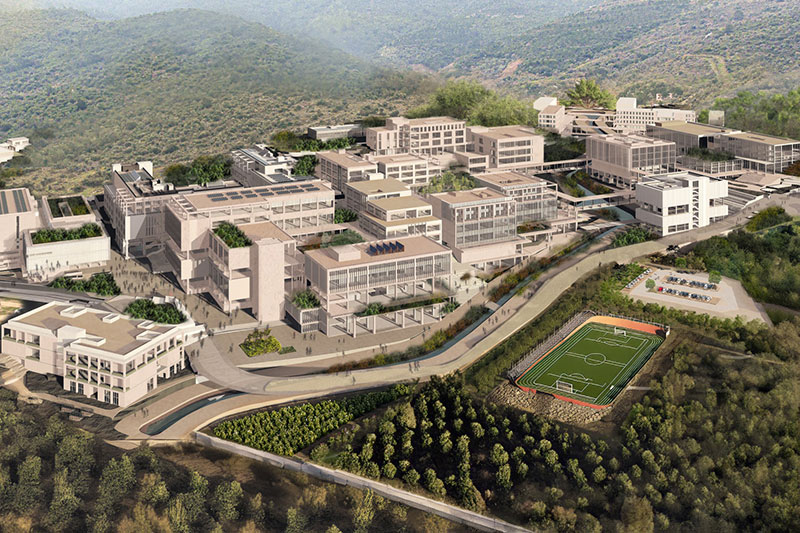
IZMIR UNIVERSITY OF ECONOMICS GÜZELBAHÇE CAMPUS
DetailsGLOBAL CAREER
As Izmir University of Economics transforms into a world-class university, it also raises successful young people with global competence.
More..CONTRIBUTION TO SCIENCE
Izmir University of Economics produces qualified knowledge and competent technologies.
More..VALUING PEOPLE
Izmir University of Economics sees producing social benefit as its reason for existence.
More..
You are one step ahead with your graduate education at Izmir University of Economics.